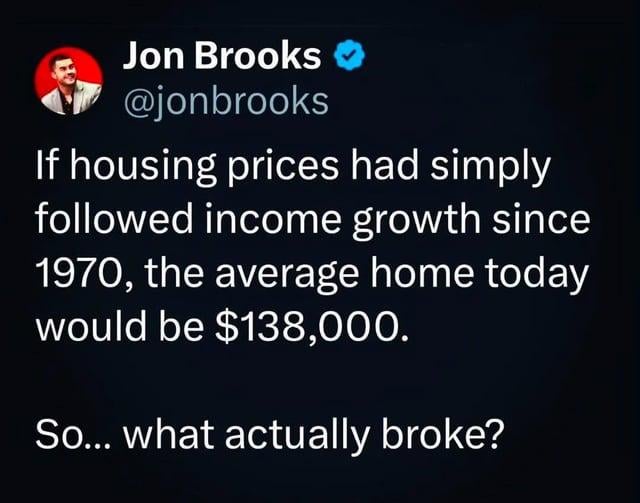
Here’s the history of US inflation in a nutshell.*
Lyndon Johnson wanted to have a Great Society and have a quick win in Vietnam. He thought that a big buildup could give the US a knockout blow, but it turned into an expensive quagmire. The US was dropping a dozen Hiroshimas worth of bombs on the jungle every week. This meant that US steel mills were working 24/7 and not getting updated. LBJ is printing money to pay for this, because he doesn’t want to raise taxes.
Nixon comes in in 1969, promising to end the war. Instead he triples down on the policy of printing money and overworking the factories. Then the Arab Oil Boycott hits. Prices of everything jumps. Many small manufacturing businesses either go broke or relocate to non-Union states. All those fancy Manhattan lofts you see today started as factory buildings.
And while the US steel mills were running day and night, Japan and Germany couldn’t get American steel, so they started building their own mills. Mills that needed a lot less power than the aging US mills. Suddenly Americans were willing to buy a tiny Japanese car instead of a Detroit model that got 6 mile to a gallon.
Jimmy Carter gets one term as President before the Iran Hostage Crisis ruins him. Carter hires Paul Volker to run the Fed and save the economy. Volker’s plan works, but it’s Ronald Reagan who gets the credit. Ronnie kept Volker in place.
Reagan has his own version of Nixon’s print and spend policy. Tax cuts for the rich and bank deregulation create an artificial boom in the 1980s that lead to a stock market ‘correction’ in 1987.
When Nixon came into office, ‘middle class’ was one Union job paying for a family of four and $1 million was considered a vast fortune that could buy a dozen houses.
By the time Bush Sr. was done, ‘middle class’ was two incomes to support the household, and $1 million was what a rich guy paid for a party.
*this is a very brief description, leaving out many details.

unitedwithme@lemmy.today 2 months ago
Private businesses being allowed to buy up the market to artificially increase prices and scarcity. How else can you ensure real estate is a solid investment stream?
schipelblorp@sh.itjust.works 2 months ago
I think that’s part of it, but a larger part–having been a local reporter–is that government is run by people trying to keep property values high. In cities, that’s real estate developers and landlords. In suburbs, it’s typical homeowners.
Most construction brings down property values: increase supply=lower demmand=lower prices. There is therefore a strong political will to oppose ALL new construction.
The second concern is: how do we keep poor people out? Things like minimal lot sizes are designed to keep the prices up and limit the amount of new citizens.
The third concern is: how can we spend the most of our money on OUR children’s education. Many suburbs are spiritually and economically designed to do ONE thing: get kids into good colleges. That means high property valuations across the board so the most money can go to individual children’s education. There are very many suburbs people don’t even move to UNLESS they’re having children, and they move out when they’re kids leave school.
If you build an apartment building in one of these suburbs and children start moving in, what happens? THe money from the rich houses is now diverted away from the rich children and towards the poor children, who are now paying much less in taxes.
I do like the oligopoly narrative, but we have to face that we are facing MASSIVE FAILURES on a social and political levels. Everybody is scrapping for themselves and building walls and pulling up ladders and basically being as self-interested me-and-mine as possible, at the same time money is becoming the dominant form of political activity with which the masses of regular people can not compete.
AdolfSchmitler@lemmy.world 2 months ago
Don’t worry, with birth rates dropping like a rock we’ll have plenty of extra houses in a couple generations, assuming humanity can make it that far.
givesomefucks@lemmy.world 2 months ago
They realized someday people pay off mortgages. No one’s ever paid so much in rent that they stopped having to pay.
WhatAmLemmy@lemmy.world 2 months ago
And these cancerous parasites are doing it to everything possible, sucking the goodness and value out of the entire planet and life itself, because their greed is a terminal mental illness.
makeshift0546@lemmy.today 2 months ago
This is nonsense. Corporations own 10% of housing. There is pressure but it’s not a primary driver people need to stop parroting this
Homes are treated as speculation and investments. NIMBY ism abound when it comes to density. Expensive labor for new home construction.
These are the primary drivers.
Zannsolo@lemmy.world 2 months ago
There’s probably another 10% owned by individual landlords with 3+ properties as well. It’s driving prices far more than you think. I’m my town something like 37% of single family homes are rental properties, if you don’t think that’s causing insane inflation of house prices in my area you’re crazy.
unitedwithme@lemmy.today 1 month ago
Dude, so much of our area has turned into corporate rentals for when they host guests, or rent them out when not needed for business personnel.
The house close to my parents went for almost 40k over asking last year, so not even in a heated market.
Waterpumpee@lemmus.org 2 months ago
Really basic 100m2 house is 450.000€ here. No basement no lot. Construction is stupid expensive since ukraine war started. Add to this, everytime there’s a sale several people demand processing fees in % of the value including state… This drives prices only up.
Doesnt help that china built their economy on real estate in the last decades, consuming lots of the raw materials. Also ever stricter regulations like insulation, heating, electricity is a point.
Companies buying homes shouldnt exist but we are at 650-750k for a 4 person home with barely any lot without that already.