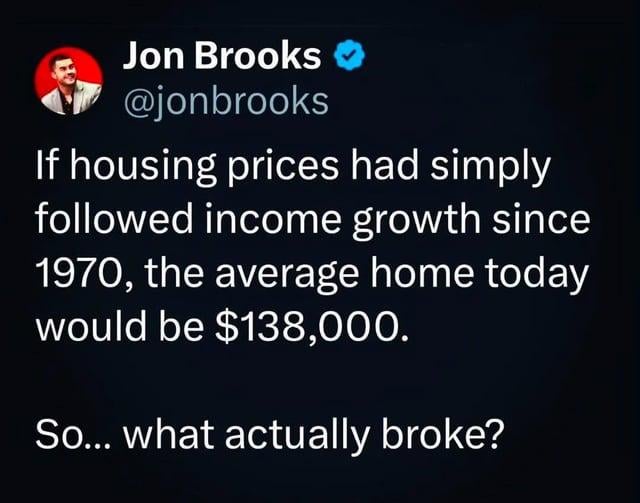
3% mortgages did tghs. If mortgages were kept around historical averages of 7 percent the asset inflation wouldn’t have occurred. The monthly costs at 7 percent currently are unaffordable except for the top 20%.
Housing prices
Submitted 2 months ago by VetOfTheSeas@discuss.online to workreform@lemmy.world
https://discuss.online/pictrs/image/85e4ddf0-dbfd-41e1-9b9c-6c1db65c3aec.jpeg
Comments
Kurtismayfield@lemmy.zip 2 months ago
Hikermick@lemmy.world 2 months ago
That’s with 7% being an average, they were in the high teens in the 80’s. Funny how that works. Rates go up, house prices go down and vice versa. Supply and demand of course but it’s as if cost of living is based on what you can afford to pay not what the product is worth. Throw in property taxes and there’s another pesky variable affecting the price. I once considered buying a vacation cabin in NY state because the price was remarkably cheap until I saw the property taxes. A mortgage gets paid off but property taxes are forever. I guess my long, rambling point I’ve piggyback onto yours is it’s more complicated than “capitalism sucks”
Kurtismayfield@lemmy.zip 2 months ago
Allowing the Fed to artificially keep interest rates down for 15 years is not “Capitalism sucks”. Its pure, unadulterated asset inflation purposely done.
stickyprimer@lemmy.world 2 months ago
Among many other things, people now vote in local elections according to “what will be good for my property value” and this often (usually) doesn’t mean making more affordable housing available. It’s a very specific case of NIMBYism. Luxury condo building with 15% affordable units? Not where it will affect my property value!
jumping_redditor@sh.itjust.works 2 months ago
It’s completely logical, if most of your wealth is in your home you want it to keep it’s value so you can move somewhere else if you want.
stickyprimer@lemmy.world 1 month ago
If “most of your wealth is in your home” you don’t have any wealth. What you have is an asset that has been made artificially scarce. It doesn’t help you at all unless you want to move to some area that doesn’t have as much artificial price inflation. However it does hurt your community significantly by making housing unavailable.
People need to think of their children, nieces and nephews before they go calling this selfish short-term thinking “completely logical.” If it’s logical at all it’s in a very narrow way to only a narrow group of people. Nothing “complete” about it.
Amnesigenic@lemmy.ml 2 months ago
Nothing broke, this is capitalism working as intended
whoisearth@lemmy.ca 2 months ago
Multiple things broke and anyone, including and especially politicians, trying to sell you on a single narrative is a lying POS.
kandoh@reddthat.com 2 months ago
Housing is an investment, so the supply of housing is artificially constrained to ensure investments stay green.
For the boomers, the house they bought was an equity vehicle designed to keep them out of poverty in their old age.
There’s also the issue of you, reading this this comment, who doesn’t want a condo or townhouse but a very specific home with a driveway, lawn, and backyard with lots of privacy. The most costly property to provide services and infrastructure for and is crippling every city’s finances for the past 50 years of white flight.
The private corporations buying homes are basically a rounding error. Human desire at scale is what’s doing this to us. Everyone wants a life sold to them as ‘normal’ by Madison Avenue executives in the 50s.
While we’re here, it’s also not data centers killing the planet - it’s billions of people who want to eat beef every day.
chronicledmonocle@lemmy.world 2 months ago
-
Private equity buyers absolutely are contributing to housing prices skyrocketing. The percentage of their effect is up for debate, but as someone who bought a home in the last few years, I was fighting big investors that were making cash offers left and right on every house I tried to get.
-
Meat production is one of the largest green house gas emitters, but data centers aren’t helping either. BOTH can be a problem. It’s and AND statement, not an OR.
kandoh@reddthat.com 2 months ago
People point to these two things because they want an easy solution and don’t want to adjust their own behaviors.
If you deleted every data center and banned private equity in real-estate we’d still be in the exact same position.
-
Captain_Buddha@lemmy.world 2 months ago
While we’re here… it’s consumerism that’s killing the planet. Waste driven by mass production (this includes beef) are the driving force behind our accelerated climate issues. The company that makes 2 million plastic landfill fodder per day, and dumps chemicals into whatever nearby future super-fund site it can find, is doing a lot more damage to the planet. Eat less or no beef, yes…but consume A LOT less of all the other shit that outweighs cattle farming for global damage.
Fluffy_Ruffs@lemmy.world 2 months ago
“There’s also the issue of you, reading this this comment, who doesn’t want a condo or townhouse”
I get this is a popular argument but when someone buys a condo or a townhouse in a shiny new development (granted you didn’t specify new but I see new condo developments being built left and right lately) where does that money go? Developers, many of which are large corporations, are making money hand over fist.
We push for more affordable housing by adding to the supply but that’s helping fatten the pockets of large development firms, further funneling money away from the people who are scraping barely enough money together to buy the units in the first place.
I’m pointing out a problem and not a solution but I think this gets lost in the “more people should be ok with condos and apartments” argument.
kandoh@reddthat.com 2 months ago
The decomodification is housing is extremely important, but individuals also have to adjust their expectations of what a good and fulfilling life for themselves will look like.
We’re all going to need to become enthusiastic advocates for high density living spaces.
ILikeBoobies@lemmy.ca 2 months ago
It was seen as an investment.
farmgineer@nord.pub 2 months ago
I fully agree with the point but is “a erage” the right metric? I also have to imagine even the average house is much larger than in 1970.
DrBob@lemmy.ca 2 months ago
Average can mean so many things. A lot of people want it to be synonymous with mean as a measure of central tendency, but there’s a reason data people use mean. It avoids folk definitions meaning typical or expected. In those senses it can also be synonymous with modal values or an area around the median etc. It’s not a precise word.
HubertManne@piefed.social 2 months ago
I was born into a house in the 70’s that was massive. Sure it was dilapidated but there were big houses. Watch caddy shack and look at the house the main character lives in that you see at the start of the movie.
Skyrmir@lemmy.world 2 months ago
The biggest reason is the number of households grew far faster than the number of houses. In constrained areas the number of households tripled, while the number of houses grew 20%. There’s no financial reform that fixes that. In remote areas cheap financing and increasing costs for construction are the largest factors.
There’s no single fix to home prices being insane. It’s going to take multiple reforms, and time for markets to adjust, plus homes to be constructed.
sp3ctr4l@lemmy.dbzer0.com 2 months ago
We got rid of pensions.
Homes and 401ks thus became financial retirement plans.
And we allowed significant interplay between the 401ks, and homes, in financial markets. It became an entire speculative industry, all intertwined and intermingled, a free for all for both old money finance and ‘entrepenuerial’ home flippers and petty landlords.
So that’s why they inflated more, basically.
Yeah it is more complicated than that but… that is the ultimate truth of it, imo.
We turned homes into speculative financial assets, so obviously, their prices became inflated and volatile.
mechoman444@lemmy.world 2 months ago
Nothing broke everything worked exactly as it was supposed to.
This is what corporatocracy looks like. Absolutely no regulation or control over the industries that sell things.
mlg@lemmy.world 2 months ago
This is technically backwards. It should be if income growth had followed inflation, the average income should hsve been ~$300,000 by now.
Zephyr@sh.itjust.works 2 months ago
E-corps playing games with housing.
HerbGrower@slrpnk.net 2 months ago
Meanwhile luxuries are cheaper than ever. But also something you could easily cut down on if you needed to. We are stuck paying increasingly higher proportions of our income to the banks in interest rates on higher mortgages and can’t really even opt out.
But I do wonder where it will go. Increasing the number of people to a household makes it far more affordable. So larger polycules are the optimal solution to the housing crisis. Don’t work 2 jobs. Split 2 jobs across 4 people all working part time.
Most housing costs change very little when you add more. Food is the most and even that you can benefit a bit with buying and cooking in bulk.
billwashere@lemmy.world 2 months ago
Greed.
explodicle@sh.itjust.works 2 months ago
People were greedy before 1970! Something changed systematically, not the human psyche.
pelespirit@sh.itjust.works 2 months ago
The corporations owning thousands and thousands of houses and buying out the markets, for sure. They’ve done it for all types of housing,
- They buy out the extra homes in major markets and then control the excess
- They price fix the ones they rent out
- They go the AirBNB route for some
If the homes that were owned by corporations were out in the market, there would be a very small housing crisis, if any.
There were articles about Microsoft, Amazon, and all the other techy companies in the Seattle area buying up small apartment buildings so they could house their H1B visa people in the early 2010s. Talk about a company town.
Seattle also took software companies to court and won that were price fixing our rentals. I’m sure they didn’t catch them all. There are a lot of shenanigans behind the scene.
sniggleboots@europe.pub 2 months ago
Me, I’m broke
melsaskca@lemmy.ca 2 months ago
The same thing that broke when our cars and food prices got so high. We need to find out what broke before it finally affects the Pokeman cards! /s
PokerChips@programming.dev 1 month ago
More population. Still the same amount of earth.
Also Republican policies.
doingthestuff@lemy.lol 2 months ago
Several things. Unrestricted illegal immigration through our completely open border during the Bush and Biden years put dramatically more demand on our system. Corporate and private investment added to that pressure. COVID and the related emergency spending and shutdowns rapidly increased the cost of new construction. I don’t know how many of you needed to buy wood in that time frame, but the cost quadrupled.
The rules of supply and demand are still king in the market, and in a relatively short period of time we ramped up demand and increased the scarcity and cost of new supply. I read earlier today about a study that showed rents have gone down in areas that ICE has targeted. I know that isn’t a popular reality for many on Lemmy but whatever.
DudleyMason@lemmy.ml 2 months ago
Yeah. Fuck it. Let’s blame immigrants. Any ol’ port in a storm to avoid acknowledging the role of commodified housing and bipartisan neoliberalism for forty fuckin years amirite?
Supply and demand mean nothing in the market unless someone can use them as an excuse to price gouge. That goes dou ly for housing. Build hundreds of new units every month and rents still don’t fall, because landleeches know that “every seller in the market wants too much, I’ll do without until prices fall” isn’t a valid choice for housing.
I read earlier today about a study that showed rents have gone down in areas that ICE has targeted.
Go ahead and drop a link to that study here, we’ll all disembowel it for you and have a good laugh at how gullible you’d have to be to attribute it to fewer immigrants and not to the massive loss in desireability for a neighborhood where masked secret police are disappearing neighbors in the middle of the night.
BigPotato@lemmy.world 2 months ago
Ah, yes, illegal immigrants with their high paying jobs buying up all the houses. Even assuming rent goes down when you remove tenants from an area (supply and demand, because how do you convince people to move into the path of the brown shirts) the question is about HOME prices. Rents are impacted by home prices, yes, but after the cost of permitting and materials, it’s ‘cheaper’ to build a second floor and raise the price by $200k than it is to build affordable homes - meanwhile the cost of smaller homes has exploded because venture capital buys them up for rentals.
If that study had any legs, or you any confidence in it, you would’ve linked it in the first place.
PenguinMage@lemmy.world 2 months ago
Quite probably the dumbest post I’ve read. But yeah, blame immigrants with demonstrably false talking points and covid (which was so pants-shittingly mishandled by the folks whose talking points you’re utilizing). None of this factors into the drastic increase in home prices over a period of time in which wages have stagnated. Somehow this is probably Obamas fault too… read a book ya mook.
sudoshakes@reddthat.com 2 months ago
11-15% of foreign born individuals own homes in the US.
Half of that group has naturalized as citizens.
So you are telling me some even smaller portion of the 7% of home ownership that is illegal immigrants is the cause of a housing crisis nationwide where universally we see increases in home pricing?
Ok.
PalmTreeIsBestTree@lemmy.world 2 months ago
I also know that if law enforcement locked up the business owners and executives who hire these “illegals”, then they wouldn’t have a reason to come here in the first place. Guess what? There’s a reason why that has never happened and there is a reason why none of what you said is the actual cause of income inequality.
uriel238@lemmy.blahaj.zone 2 months ago
Also in 1971, the Powell memorandum was written and submitted to the Chamber of Commerce.
CokeVoAYCE@lemmy.world 2 months ago
how does this relate to inflation? like i know housing went up more than it should but that’s still a more accurate comparison
explodicle@sh.itjust.works 2 months ago
I don’t think the post said anything about inflation but I suppose it kinda relates because both things do cost more dollars than they used to.
Keynes predicted we’d have a 15-hour work week by now-ish. This was not the plan. Hell, we only adopted the Keynesian rationale after Tricky Dick ““temporarily”” broke the Bretton Woods Agreement in 1971.
Jarix@lemmy.world 2 months ago
Home have different material requirements and construction requirements that means they are(should be if built correctly…) safer and more complex. Also houses are MUCH bigger than they used to be.
That’s not to say there isn’t a problem but it’s not just inflation that has made housing costs more expensive
Malyca@lemmy.zip 2 months ago
Older people wanting to tie their wealth to their homes
dropped_the_chief@lemmy.world 2 months ago
Lack of worker power
Professorozone@lemmy.world 2 months ago
Source?
raze2012@lemmy.world 2 months ago
Math.
fred.stlouisfed.org/data/MSPUS
Plug 23900 into an inflation calculator
data.bls.gov/cgi-bin/cpicalc.pl?cost1=23900&year1…
I got 211,149.54.
Guess they had different numbers or calculator, but similar sentiment. Housing grew some 5x+ faster than inflation.
Professorozone@lemmy.world 1 month ago
Yeah, I can do the math. It was the first link you sent I was interested in. Thanks for providing it.
Cherry@piefed.social 2 months ago
Women went out to work.
x0x7@lemmy.world 2 months ago
The Fed lowered interest rates. Now your savings pay nothing, and your home is too expensive. Works for boomers though. Their home being too expensive is a good thing. But they won’t live to enjoy that wealth. And now we are in a Faustian trap. Make housing affordable (important and right thing to do) and with it we have to see the a ton of normal people go underwater on a leveraged investment.
But if we slowly raise interest rates we could avoid the shock.
Side benefit. AI’s hype train depends on being able to operate at a mammoth loss for the foreseeable future. That also depends on artificially low interest rates. Raise them, not only can you make housing affordable, but you also might kill AI.
There would be some job loss. All the AI jobs would go. I’m ok with this.
Boozilla@sh.itjust.works 1 month ago
The answer is always greed.
WudgieLore@lemmy.zip 2 months ago
So did you fix it?
rmrf@lemmy.ml 1 month ago
Every home must serve as a primary residence at least 183 days out of the year + single family structures cannot be used for profit
gandalf_der_13te@feddit.org 1 month ago
i think that lots of things broke. the biggest issue seems to me that the american public (and unfortunately also large parts of the european public) have been convinced that they need “more” - that they need bigger houses, cars, etc.
the consequence is that new houses are bigger, and therefore more expensive.
gandalf_der_13te@feddit.org 1 month ago
there’s also other issues that are sometimes being quoted, such as: housing being seen as a commodity, housing being held by a few big house-owners. but i’m not convinced that that alone could cause prices to skyrocket.
if there’s a whole lot of developers trying to gain from housing economy, then there would be more houses being built until there’s more housing supply than demand, then prices would go down again until they stabilize somewhere. but that doesn’t seem to be what’s happening.